
The "Me Do It!" Phase
The "Me Do It!" Phase (The State Primer - Visual, Auditory, Kinesthetic)
You are standing in the kitchen, brewing your morning coffee. The rich aroma fills the air (Visual/Smell). Suddenly, you feel a small tug on your pant leg (Kinesthetic). You look down to see your toddler staring up at you, urgently declaring, “Me do it!” (Auditory).
You want to include them in your daily routine, but the real hot water, fragile ceramic mugs, and heavy machines are simply too dangerous. Your first instinct might be to buy a cheap, plastic pretend kitchen from a big-box store. But when you bring it home, it flashes neon lights, plays loud robotic music, and feels flimsy. Instead of feeling like a “big kid,” your toddler gets quickly bored and goes back to tugging at your leg.
Why? Because children are incredibly perceptive. They know the difference between a cheap distraction and the real thing.
Olivia Miller (The Harmonizer) faced this exact daily struggle with her 4-year-old son, Noah (The Performer). “Noah didn’t want to play with a noisy plastic machine,” Olivia explains. “He wanted to be a part of our morning ritual. He wanted to feel the weight of a cup, the mechanics of a coffee pod, and the pride of serving us.”
At Cuzy Mart, we understand that true play is actually preparation for life. We have curated a collection of premium, wooden Montessori kitchen accessories designed not to distract your child, but to empower them.

The Montessori Philosophy: "Practical Life" Over Pretend Play
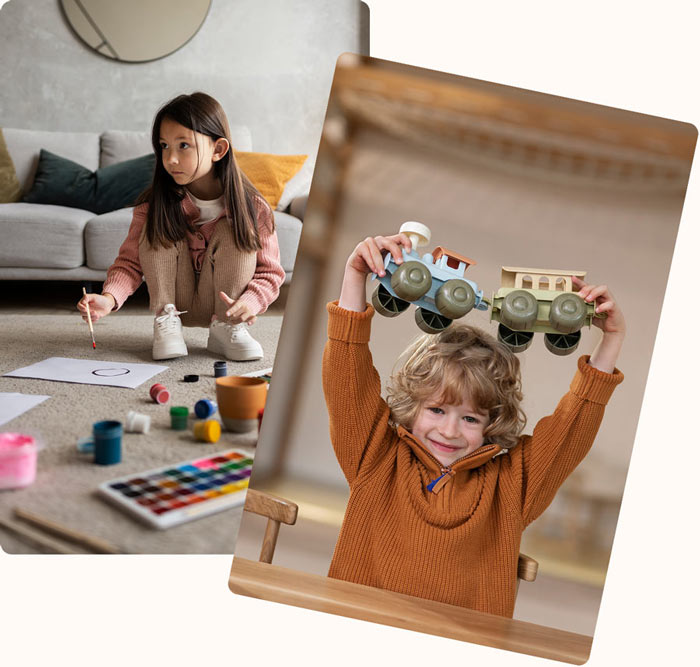
In the Montessori method, kitchen play falls under a crucial category called “Practical Life.” Unlike traditional “pretend play” where a child uses a magic wand to fight dragons, Practical Life activities are grounded in reality. Children possess a deep, biological drive to mimic the adults around them. When you provide them with high-quality, realistic Montessori kitchen accessories, you are answering that drive.
Here is what happens in your child’s brain when they use realistic, wooden kitchen tools:
-
The "Heavy Work" Sensory Input
Plastic is too light; it provides no feedback to the muscles. Solid wood has "weight." Lifting a wooden teapot requires actual muscle control and spatial awareness, building their gross and fine motor skills.
-
Sequencing and Logic
Making a cup of pretend coffee isn't random. It requires a sequence: Place the cup -> Insert the pod -> Turn the dial -> Serve. This step-by-step logic is the exact same neural pathway used later for solving math problems.
-
Social Confidence
Serving tea or coffee to a parent or sibling builds immense emotional intelligence and a sense of belonging. They transition from being "the baby" to being "a contributing member of the family."
Let’s explore the top 3 wooden tools that will transform your child from a kitchen bystander into a confident chef.
The Top 3 Montessori Kitchen Tools for Toddlers
When curating the Cuzy Mart kitchen collection, Olivia Miller looks for tools that offer realistic mechanical feedback and aesthetic beauty. “A child’s environment should be as beautiful and functional as an adult’s,” she notes. Here are the three tools Noah uses daily in his “Practical Life” corner.
The Social Host: Montessori Silicone & Wood Tea Set
- Best For: Fine Motor Control, Emotional Intelligence & Social Etiquette.
- The Concept: A beautifully muted, premium set combining the unbreakable safety of food-grade silicone with the warm, tactile feedback of natural wood.
Why It Works (The Miller Analysis):
Pouring liquid (or even pretend air) from a teapot into a tiny cup without spilling is a masterclass in physics and wrist control. When Noah practices this motion, he is refining the hand-eye coordination required for independent eating and, eventually, handwriting.
A tea party is rarely a solo activity. It requires a “Host” and a “Guest.” Olivia uses this set to help Noah practice social scripts: “Would you like some tea? Yes, please. Thank you.” This structured role-play builds the foundation of empathy and polite communication.
The silicone cups are soft and safe for teething, while the wooden saucers provide a sturdy base. It’s the perfect transition from “baby toys” to “big kid tools.”
The Verdict: It is an elegant tool for teaching manners, sharing, and precise physical control in a safe, unbreakable format.
Montessori Silicone & Wood Tea Set
The Verdict: It is an elegant tool for teaching manners, sharing, and precise physical control in a safe, unbreakable format.
The Morning Barista: Montessori Wooden Coffee Maker Set
- Best For: Complex Sequencing, Executive Function & Routine Integration.
- The Concept: A highly realistic, solid wood espresso machine featuring mechanical clicking dials, removable wooden coffee pods, and a matching cup.
Why It Works (The Miller Analysis):
Toddlers idolize their parents. When Noah watches his dad, Ethan, make coffee every morning, he wants to participate. Giving Noah his own wooden coffee maker validates his desire to be capable. It says, “You are big enough to have your own machine.”
Making this pretend coffee is not a one-step process. Noah has to follow a logical sequence: 1. Place the cup. 2. Insert the flavor pod. 3. Turn the dial. 4. Serve. This multi-step process trains his “Executive Function”—the part of the brain responsible for planning, memory, and task execution.
The dial on the side of the machine isn’t just painted on; it actually clicks when turned. This auditory and tactile resistance satisfies the toddler’s need to manipulate moving parts, strengthening their hand muscles.
Montessori Wooden Coffee Maker Set
The Verdict: It turns a chaotic morning routine into a moment of shared connection. You make your coffee; they make theirs. Everyone starts the day with a sense of accomplishment.
The Morning Barista: Montessori Wooden Coffee Maker Set
- Best For: Complex Sequencing, Executive Function & Routine Integration.
- The Concept: A highly realistic, solid wood espresso machine featuring mechanical clicking dials, removable wooden coffee pods, and a matching cup.
Why It Works (The Miller Analysis):
Toddlers idolize their parents. When Noah watches his dad, Ethan, make coffee every morning, he wants to participate. Giving Noah his own wooden coffee maker validates his desire to be capable. It says, “You are big enough to have your own machine.”
Making this pretend coffee is not a one-step process. Noah has to follow a logical sequence: 1. Place the cup. 2. Insert the flavor pod. 3. Turn the dial. 4. Serve. This multi-step process trains his “Executive Function”—the part of the brain responsible for planning, memory, and task execution.
The dial on the side of the machine isn’t just painted on; it actually clicks when turned. This auditory and tactile resistance satisfies the toddler’s need to manipulate moving parts, strengthening their hand muscles.
Montessori Wooden Coffee Maker Set
The Verdict: It turns a chaotic morning routine into a moment of shared connection. You make your coffee; they make theirs. Everyone starts the day with a sense of accomplishment.
The Little Baker: Montessori Wooden Tea Party Tray & Pretend Pastry Set
- Best For: Early Math (Fractions), Aesthetic Appreciation & Fine Motor Sorting.
- The Concept: A stunning, smooth wooden serving tray complete with modular, beautifully painted wooden pastries, cakes, and a serving knife.
Why It Works (The Miller Analysis):
Olivia uses this set for more than just pretend eating; it is Noah’s first math lesson. When Noah uses the wooden knife to “slice” a piece of cake to share, he is visually and physically learning about fractions (a whole, a half, a quarter). This hands-on geometric experience makes future abstract math much easier to grasp.
Fitting the various pastries back onto the tray like a puzzle challenges a toddler’s spatial reasoning. They have to categorize the items by size and shape to make them fit, which is a core cognitive skill.
The smooth finish and non-toxic, muted colors respect the child’s environment. It teaches Noah to handle beautiful things with care, a principle central to the Montessori “Practical Life” curriculum.
Montessori Wooden Tea Party Tray & Pretend Pastry Set
The Verdict: It is a delicious blend of early mathematics, fine motor control, and hosting etiquette, all served on a beautiful wooden tray.
Final Verdict: Preparation, Not Pretend
When you buy a flashing plastic kitchen set, you are buying a temporary distraction. But when you invest in best montessori kitchen accessories, you are buying tools for life.
Children like Noah don’t want to live in a fantasy world all the time; they desperately want to be capable members of our world.
Children like Noah don’t want to live in a fantasy world all the time; they desperately want to be capable members of our world.
The Tea Set
The Coffee Maker
