
The "Plastic Trap" and the Cardboard Box
Walk into any big-box toy store, and it is easy to feel instantly overwhelmed. You see aisles packed ceiling-high with neon plastic toys (Visual). You hear a chaotic symphony of robotic voices, flashing sirens, and electronic music designed to hijack your baby’s attention (Auditory). You pick one up, feeling the cheap, hollow plastic, and you buy it, hoping it will make your baby “smarter” (Kinesthetic).
Yet, as a parent, you’ve likely experienced the ultimate frustration: you bring the fancy, $50 flashing robot home, and your baby plays with it for exactly two minutes—and then spends an hour happily chewing on the cardboard box it came in.
Why does this happen? Because babies do not need to be entertained; they need to be engaged.
Ethan Miller (The Wise Builder) is an engineer who believes in purposeful design. When he watched his youngest son, Max (The Sensory Explorer), interact with a loud electronic toy, Ethan noticed a critical flaw. “The toy was doing all the work,” Ethan explains. “It flashed and sang while Max just sat there, passively watching. But when Max grabbed the cardboard box, he had to figure out how to open it, how it tasted, and how it sounded when he banged it. The box required his brain to work.”
At Cuzy Mart, we embody the philosophy of the “Wise Giver” and strictly follow the Montessori principle: “Play is the work of the child.” For a baby between 6 and 12 months, this “work” is serious business. They don’t need a toy that plays the music for them; they need tools that invite them to create the rhythm.
We have curated a list of the top 3 essential Montessori tools for this specific age group. These aren’t just toys; they are developmental milestones in wooden form. Let’s help you build a playroom that grows with your child’s brain, not one that ends up in the trash.
Understanding the 6-12 Month Leap: It’s Not Just About Sitting Up
Before we dive into the specific tools, it is crucial to understand why this age range is so magical—and so demanding. Between 6 and 12 months, your baby undergoes a massive neurological transformation often called the “Sensorimotor Explosion.”
Ethan looks at this phase like building the foundation of a house. “You can’t build the roof until the foundation is solid. In the first year, a baby’s brain is pouring the concrete for every future skill,” he notes.
Here is what is happening under the surface:
Why does this matter for your toy shopping? Most generic toys are designed to entertain a passive child. But a child in this 6-12 month phase is an active, hungry scientist. They need physical tools that challenge their new motor skills and respect their rapidly growing intellect.

Physical Freedom
They transition from lying flat to sitting, crawling, and pulling up. This means their hands are finally free from supporting their body weight, allowing them to actively explore their environment.

The Pincer Grasp
Around 9 months, they stop grabbing objects with a clumsy, whole-fist motion (palmar grasp) and start using their thumb and index finger (pincer grasp). This tiny physical change is a massive cognitive leap; it is the direct precursor to holding a pencil later in life.

Cognitive Awakening
They begin to understand cause and effect ("If I swat this drum, it makes a sound") and the critical concept of Object Permanence ("If Mom leaves the room, she still exists").
The Top 3 Montessori Tools for the 6-12 Month Brain
Ethan Miller tests every item in the Cuzy Mart collection based on three strict engineering criteria: Engagement (Does it hold focus without passive entertainment?), Durability (Can it survive a toddler’s drop-test?), and Education (What specific neural pathway is it building?).
Here are the tools that passed the “Miller Standard” for Max’s playroom.
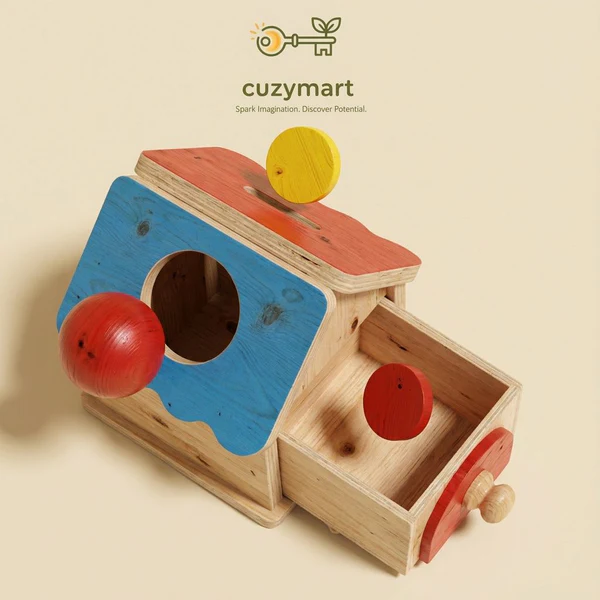
The Essential: Montessori Wooden Object Permanence House
- Best For: Solving Separation Anxiety & Teaching Logic.
- The Concept: This is the undisputed “gold standard” of early Montessori education. It consists of a meticulously sanded, solid beechwood box with a tray and a heavy red wooden ball.
Why It Works (The Miller Analysis):
As we discussed in our comprehensive guide on Object Permanence, this box is essentially a therapy tool disguised as a toy. When Max drops the ball in, it vanishes. When it rolls out a second later, his brain registers: “Things that disappear will come back.” This logic directly reduces separation anxiety when parents leave the room.
Grasping the ball and fitting it precisely into the top hole requires intense focus and high-level hand-eye coordination.
Ethan loves the acoustics of this tool. “The satisfying ‘thud’ of the heavy wooden ball hitting the base gives Max immediate, natural confirmation of his action. No flashing lights needed—physics does the teaching.”
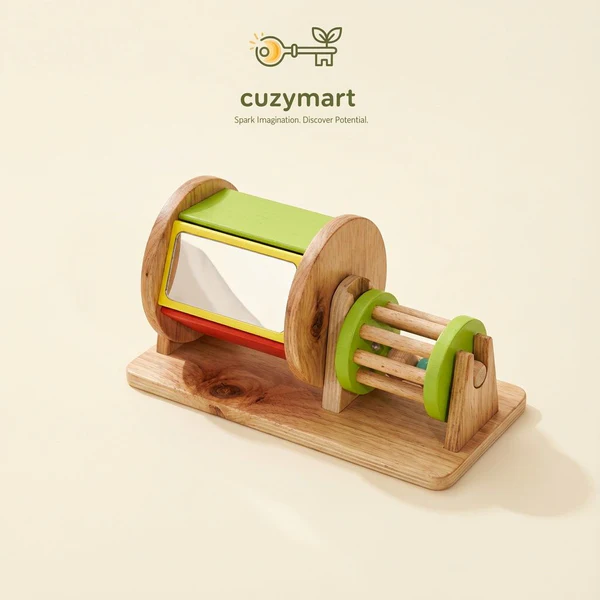
The Motivator: Montessori Spinning Drum & Rolling Rattle Set
- Best For: Surviving Tummy Time & Building Wrist Strength.
- The Concept: A beautifully crafted, colorful spinning wooden drum with a mirror and gentle acoustic bells inside, paired with an easy-to-grasp rolling rattle.
Why It Works (The Miller Analysis):
 Let’s be honest, many babies despise tummy time. Lifting a heavy head feels like a grueling gym workout. This drum is the perfect “bribe.” When Ethan places it in front of Max, the spinning colors and gentle sound give Max a mission: Reach out and make it move. It distracts from the physical effort.
Unlike simple static blocks, making the drum spin requires a specific “swatting” and wrist-rotation movement. “This isn’t just play,” Ethan notes. “This mechanical resistance strengthens the exact forearm and wrist muscles Max will eventually use to hold a spoon and write with a pencil.”
The bells inside produce a soft, rhythmic chime—not a loud electronic shriek. As the drum spins, the alternating colors force the baby’s eyes to track a moving target, building the visual convergence skills needed for future reading.
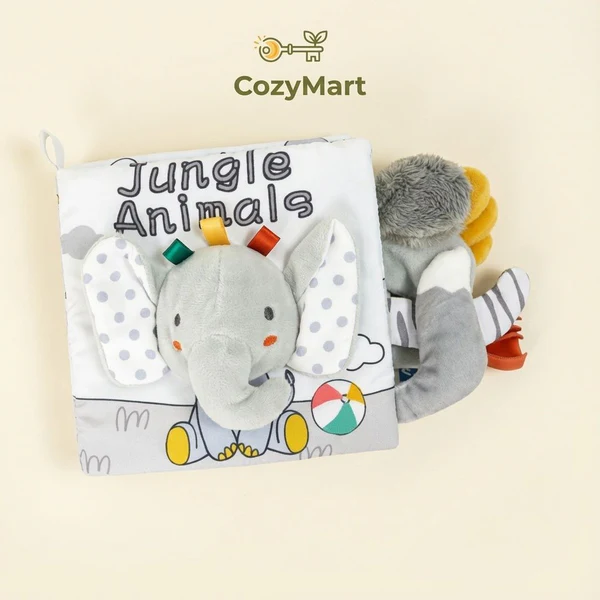
The Quiet Explorer: Montessori Soft 3D Jungle Sensory Book
- Best For: Sensory Stimulation, “On-the-Go” Play & Seated Balance.
- The Concept: A premium, soft fabric cloth book featuring interactive 3D animal tails, hidden crinkle pages, and high-contrast visual scenes.
- Â
Why It Works (The Miller Analysis):
Olivia Miller (The Harmonizer) designed Max’s sensory environment knowing that at this age, babies “read” with their fingers and mouths. “The different textures of the animal tails—fuzzy, silky, rough—send immediate sensory data to Max’s brain, building his early understanding of the physical world,” she explains.
Let’s face it—paper books get ripped, and board books get chewed into a pulp. This cloth book is designed to be drooled on, pulled, and squashed. It is 100% washable, making it the safest, most hygienic option for a aggressively teething baby.
Unlike loud plastic tablets, the “crinkle” sound hidden in these pages teaches cause and effect silently. It captures their attention immediately without disturbing others, making it the ultimate tool for restaurants, car rides, or waiting rooms.
Final Verdict: Quality Over Quantity
It is incredibly tempting to fill the nursery with dozens of toys, hoping one of them will magically keep your baby occupied. But child development research—and the Miller family philosophy—tells us a different story: Less is more.
A 6-month-old baby doesn’t need 50 toys to scatter across the floor. They need a few, highly intentional tools that respect their intelligence and invite them to master a skill.
The Object Permanence House
The Spinning Drum
The Jungle Book
Stay Connected With Us Subscribe Now!
Unlock exclusive family rewards and purposeful play templates! Enter your email to join the Cuzy Mart community and get early access to our handcrafted collections.
Add your first comment to this post