




Growing Smiles Every Day
The Science of Object Permanence Why Your Baby Cries When You Leave
Imagine this scenario
The "Bathroom Break" Meltdown
Imagine this scenario: You are sitting on the floor with your 8-month-old. They are surrounded by their favorite wooden toys, happily babbling, completely engaged and safe (Visual). You slowly stand up to walk just ten feet away to the kitchen to grab a glass of water. Suddenly, the peaceful babbling shatters into a piercing, panicked scream (Auditory). You freeze. You feel your heart race and a heavy knot of guilt form in your stomach, as if your simple act of walking away has somehow broken their world (Kinesthetic).
As a devoted parent, this phase is incredibly exhausting. You might find yourself standing in the hallway thinking, “Is my baby too clingy? Am I creating bad habits? Why can’t I just go to the bathroom in peace?”
Take a deep, reassuring breath. At Cuzy Mart, we want you to know that your baby isn’t being “manipulative” or “spoiled.” They are currently grappling with one of the most profound cognitive leaps in human evolution. They are trying to understand the terrifying, complex physics of Object Permanence.
“There was a month where I couldn’t even step out of his line of sight to check the oven, His panic was so real, it broke my heart”
With his engineering mindset, helped reframe the situation for the family. He explained that Max wasn’t having an emotional breakdown; he was having a “Data Processing Error.”
“To an adult, reality is continuous,” . “If I put my car keys in a drawer, I know they still exist. But Jean Piaget, the pioneering developmental psychologist, proved that for an infant, ‘Out of sight’ literally means ‘Out of existence.’ When Olivia walked to the kitchen, Max didn’t think she was in another room. His developing brain told him she had vanished into the void.”
Understanding the science behind the tears makes them easier to handle. This guide will walk you through exactly what is happening in your baby’s neural pathways, why they panic when you leave, and how specific tools can help them build the logical confidence that “Mommy always comes back.”
The Timeline: How Object Permanence Develops (0–24 Months)
Object permanence isn’t a switch that flips overnight. It is a slow, complex neurological process that unfolds in stages. You can actually observe these distinct milestones in your own living room as your baby’s brain wires itself for logic.
Stage 1: 0–4 Months
In the newborn phase, the world is a pure sensory experience. If they are looking at your face, you exist. If they turn their head away, you cease to exist.
- The Behavior: If you show a 3-month-old a bright red ball and then cover it completely with a blanket, they won’t try to look for it. They will simply lose interest. To them, the ball didn’t “hide”—it evaporated.
- The Emotional State: Generally calm regarding separation, because they do not yet have the memory capacity to “miss” a specific person who isn’t physically present.
Stage 2: 4–8 Months
This is the transition phase. Their vision is improving, and the first files in their memory cabinet are forming.
- The Behavior: If you partially hide a toy (leaving a bit sticking out), they will reach for it. They are starting to understand that the whole object is there, even if partially obscured.
- The Game: This is why Peek-a-Boo starts to become hilarious around 5 or 6 months. You cover your face, and they wait with wide-eyed anticipation. When you reveal yourself, the joy comes from the confirmation: “I knew you were there!”
Stage 3: 8–12 Months
This is the most fascinating—and frustrating—stage for parents. It is also when separation anxiety typically begins to spike. Your baby knows objects exist, but their logic is still “glitchy.”
- The “A-not-B Error” Experiment: 1. You hide a toy under Blanket A. The baby finds it. (Success!) 2. You repeat this a few times. 3. Then, while the baby is watching directly, you move the toy under Blanket B.
- The Glitch: The baby will still look under Blanket A!
- The Science: Their brain has associated the physical action of looking under Blanket A with the reward of finding the object, rather than tracking the actual trajectory of the object itself.
Stage 4: 12–18 Month
By this age, Ethan notes, the “system update” is complete. The glitch is fixed. They can track invisible displacement. If you put a toy in a box and move the box, they know the toy is inside.
- The Result: They know you are “somewhere” in the house. This is why a toddler will confidently crawl to the bathroom door and bang on it. They know you are behind the wood, and they want access.
The Great Paradox: Why Being Smarter Means More Crying
It seems contradictory to Olivia. “If Max now knows I still exist when I leave the room, shouldn’t that make him feel better?” she wondered. Logic suggests that knowing “Mom is just in the kitchen” is far less terrifying than believing “Mom has vanished from the universe.”
Yet, Ethan points out that the neurological development of object permanence is exactly what triggers the most intense, heart-wrenching waves of separation anxiety. Here is why this incredible cognitive leap causes such a fierce emotional storm:

Memory Without Logic (No Concept of Time)
Your baby now remembers you. They have a clear, comforting mental image of your face. But they lack a concept of time. To a baby, the word "later" is meaningless. They feel the sharp pain of your absence now, but their prefrontal cortex cannot yet grasp the promise of your return in 5 minutes.

The Terrifying Loss of Control
Before this stage, their world was small and manageable. Now, they realize the world is vast, and you possess the autonomy to move around in it without them. This realization is terrifying; they are suddenly acutely aware of their own vulnerability and dependence.

The "Check-In" Reflex
Because they know you are somewhere, they feel a compulsive, biological need to check. Are you still there? What about now? When they cannot see you to verify your presence, panic naturally sets in.

Tears As Compliments
So, when your 9-month-old screams as you walk away, it is actually a profound compliment. It means their memory is working perfectly, their spatial awareness is expanding, and their attachment to you is powerfully strong.

How Montessori Helps: Building Trust Through "Work"
You cannot rush brain development, and Clara Miller (The Empathetic Listener) gently reminds parents that you cannot (and shouldn’t) prevent separation anxiety entirely. It is a healthy, necessary processing of complex emotion.
However, you can provide physical tools that help your baby process this abstract concept faster and with far less fear. Dr. Maria Montessori observed that babies learn abstract concepts (like “existence” and “trust”) through concrete physical actions. You cannot explain logic to a baby with words, but you can teach it to their hands.
The Concept of "The Return
In the Miller home, Arthur (The Master Craftsman) crafted specific materials to isolate the concept of disappearance and return. The goal is to turn a scary, uncontrollable experience (Mom leaving) into a safe, controllable game (The Ball leaving).
Practical Ways to Support This Milestone
You don’t need to be a neuroscientist to help your baby navigate this phase. You just need to change how you play. Here are the most effective, research-backed ways the Miller family builds object permanence at home.
The Classic: Peek-a-Boo (With a Twist)
It’s the oldest game in the book for a reason. But to maximize the cognitive workout, Clara suggests these variations:
- Face Hiding: Cover your eyes. Let them physically pull your hands away to “reveal” you.
- Toy Hiding: Instead of hiding yourself, hide their favorite rattle under a blanket. Leave a small part sticking out at first (giving them a visual clue), then eventually hide it completely. Watch them lift the blanket to “find” it. This directly combats the “A-not-B error” we discussed earlier.

The Essential Tool
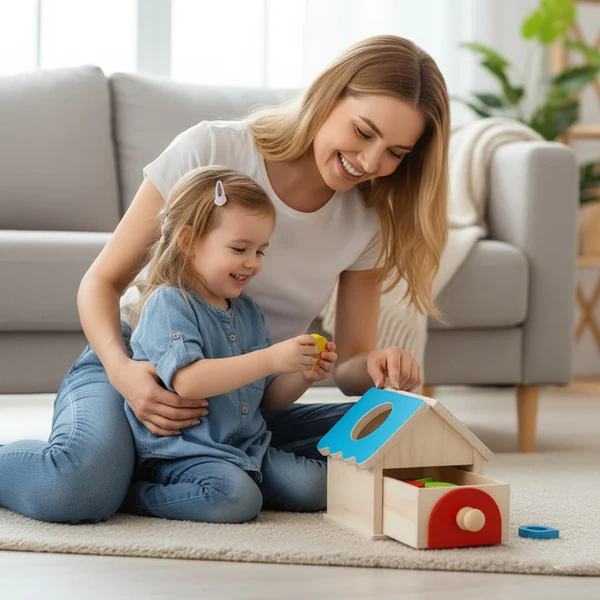
The Object Permanence Box In a true Montessori environment, you will always find a specific wooden tool designed solely for this milestone. At Cuzy Mart, we recommend the Montessori Wooden Object Permanence House for babies aged 6-12 months.
Stop "Ghosting" Your Baby
Many parents think the best way to leave the house is to sneak out while the baby is distracted. Clara heavily advises against this. When you sneak away, you confirm your baby’s worst fear: that you can vanish unexpectedly into thin air at any moment. This creates lasting hyper-vigilance.
- The Fix: Always say goodbye. “I am going to the store. Grandma is here. I will be back”. Even if they cry, you are building a foundation of truth. You are telling them what will happen, and when you return, you prove that you keep your promises.

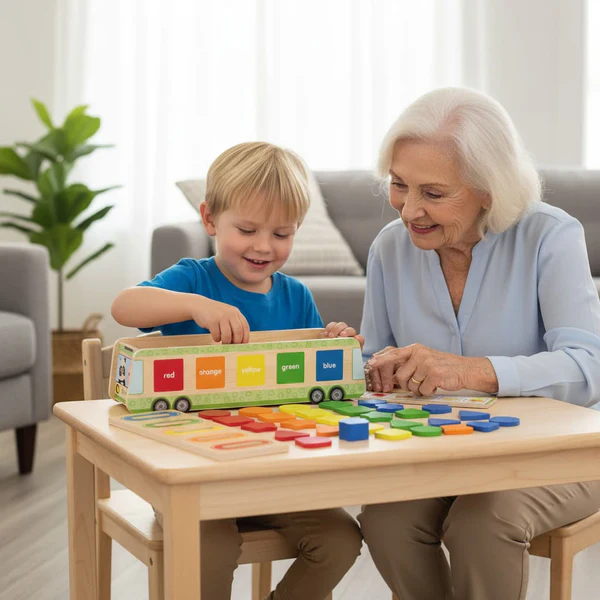
Advanced Play: The Montessori Color Sorting Bus (10+ Months)
As your baby masters the simple ball drop, their understanding of object permanence becomes more sophisticated. They are ready for "Imbucare" (an Italian Montessori term for "posting" or "putting into").

Unlock exclusive family rewards and purposeful play templates! Enter your email to join the Cuzy Mart community and get early access to our handcrafted collections.
Add your first comment to this post